Blog

Individual Climate Action Does Work… If It Has These Three C’s

How to take action that does more than just make you feel better
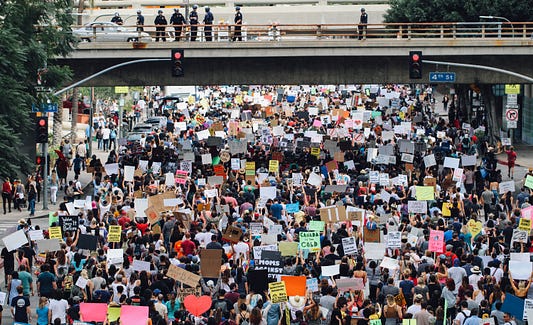
Photo by Alex Radelich on Unsplash

When talking to environmentalists, I often come across discussions of the value of individual action. The question is framed a number of ways:

  • Which is better, individual action or collective action?
  • Can individual action succeed without cooperation from governments and leaders?
  • Is there any point in individual action?
  • Are we just supposed to passively wait around for the collective? What about our agency?

And so on. It’s like “individual action” and “collective action” are two choices on the menu, and we can only pick one. You also see this framing in news and opinion pieces.

This question doesn’t make a ton of sense to me. You can’t have one without the other, because every collective is made up of individuals. Any collective change that happens is coming from (some of) them.

And if you are planning to take action, the question of whether to take ‘individual’ action is moot. It’s not like you have the choice not to be an individual.

I believe what people are really asking is slightly different.

They want to know if their efforts will be purely performative. They’re worried the actions they could take — making lifestyle changes, signing petitions, going to protests —won’t have any effect other than making themselves feel better.

In my opinion, the difference is not in the choice of action itself. Successful movements are built out of sharing messages, including the very activities we sometimes dismiss as ineffective.

What outcome are we aiming for?

Social change often happens through social tipping points (the concept popularized by Malcolm Gladwell’s famous book).

A tipping point is the colloquial term for a phase transition, or the phenomenon where incremental changes in a system reach a critical threshold, leading to rapid transformation.

Social change has always been sudden and nonlinear. Think of the changes we’ve witnessed in our own lives, like changing opinions toward smoking, the emergence of the MeToo and Black Lives Matter movements, and rise of support for Ukraine. Public opinion changed slowly, then all at once.

The term ‘phase transition’ originally referred to matter changing phases, like water turning to ice. The interesting thing is where the ice starts — it’s not like one corner turns to ice and the change spreads from there. Instead, it happens locally, through a process called nucleation. Small particles of ice form all over the material, and grow until everything is ice.

I believe this is how the climate movement grows. It’s not one silver bullet that fixes everything, but accelerating changes originating in multiple parts of society. Grassroots movements around the world, speaking up where they are most likely to be heard, and coordinating among each other.

If this is the outcome we are hoping for, we can see a hint at what makes individual actions effective: when they create the conditions for social tipping points.

You’re still one person, but your actions are a part of a ripple effect spreading through the whole social system.

If you are taking action on any scale, that is already valuable, because it’s a step in the journey. However, if you have the capacity and are looking for ways to amplify your results, here are the 3 C’s that I believe make the difference.

C for Coordination

There’s a difference between writing a letter at random and participating in a letter campaign. There’s a difference between “trying to shop greener” and taking part in an organized boycott.

That difference is the first C: Coordination.

Without it, we are all participating in a million boycotts at once, and canceling out our efforts as we start and fall off when they get difficult to maintain.

But when we coordinate our efforts, we get unprecedented outcomes like over a 1000 companies ending operations in Russia in mere months. It’s because coordination brings other things with it, like focus, passion, and media attention.

What that means for us is that we need to find campaigns (whether they are calls, letters, or boycotts) and join them.

The best way to do that is to find a climate organization that aligns with your priorities, and sign up to its email list. (This can be a task in itself, but it gets easier once you’re plugged into that ecosystem. I’ve written about how to get started here.)

That way we are throwing our efforts behind a viable engine.

And we can amplify those efforts with the second ‘C’…

C for Communication

When you find a method of action that works, share it! You spent the effort to sift through opportunities and make them work. Let that effort benefit someone in similar circumstances: equally busy, with similar skills or misgivings. Friends, family, people at your meetup groups. There’s someone in your circle who wants to do more, and you are the right messenger.

Anand Giridharadas writes that progressives need to be more “small-e evangelical” about our causes. Talking about climate change has been an awkward taboo for too long. Let’s replace the outdated cultural narrative on climate change with a new, better one! To do that, we need to each be conduits for good ideas to spread.

And one of those good ideas? A clear picture of what we are working toward. That brings us to the last ‘C’ …
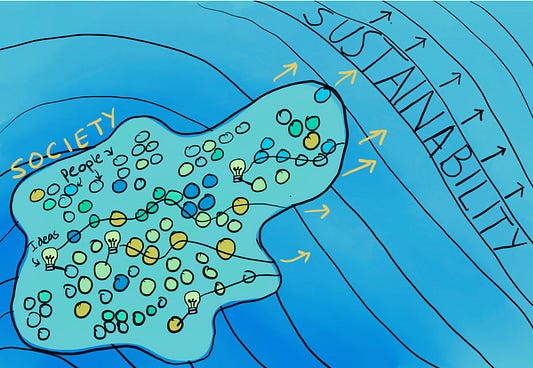
Illustration of social change, by the author

C for (theory of) Change

Visualizing success is all the rage. While I’m not a fan of the excesses of ‘manifesting’ culture, there’s no denying that knowing what you are aiming for provides clarity, and there is a clear need for it in the climate movement.

We’re often cautious to stake a claim about the future, because, of course, predicting the future is impossible. I’m rather afraid of making predictions myself, whether rosy or apocalyptic.

None the less, to be strategic in our actions, we need to imagine the small, intermediate outcomes we are seeking. Such as, a regulation being passed in your city, adoption rates for solar panels going up, your company reducing its emissions year-over-year.

This exercise is referred to as Theory of Change. The United Nations Development Group defines it as

A theory of change is a method that explains how a given intervention, or set of interventions, is expected to lead to specific development change, drawing on a causal analysis based on available evidence.

On a personal scale, we might do this more informally. We need to be clear on the mechanism by which we expect our actions to improve the global response to climate change.

We often have a vague idea of how our actions help. You might be surprised at what a difference it makes to think through the details of how we can influence specific outcomes.

The exact results or numbers may be hard to calculate, but they don’t matter. We only need to compare the actions we have available. Our best guess at the results is good enough for identifying which actions are worth pursuing and cutting out the distractions.


With the climate crisis, the problems facing us are vast, but so are the numbers of people who want to solve them. The key is to line up and amplify their efforts.

Coordination, Communication, and (theory of) Change: these are the three factors that turn your individual efforts into a solid building block of the kind of movement we need.
Here’s my free resource to overcome overwhelm and find clarity on YOUR personalized next step to protect the environment.

Originally appeared in Age of Awareness.

Understanding Time Poverty Is Key in Addressing Climate Change

Recently, I’ve been noticing that the more sustainable/climate-conscious lifestyle option in our existing society is often the slower one. This means that ‘busyness’ or time poverty is a major barrier to the adoption of behavior changes to address climate change. 

It’s important to address these barriers, because behavior changes like changing purchasing decisions, household behaviors, travel habits, and diet are necessary. (In concert with market, policy, and cultural changes — they all build on each other.) 

For example, I started taking public transport again, for the first time in years. I noticed how it changed the structure of my entire day. Not only did I have to plan around the bus schedule and factor in a longer commute time, but the addition of a walk to the bus-stop and people-watching opportunities made the day feel much slower and calmer.

There are other changes I’d like to make: shopping at farmer’s markets. Cooking more of my meals. Walking or biking places. Taking the train instead of flying. In each case, time is the main constraint.

I’m determined to find a way, because I enjoy these activities more than the modern quick-easy-packaged-default alternative. The problem is that these options are not available to most people.

What is time poverty?

Time poverty is defined as the “chronic feeling of having too many things to do and not enough time to do them,” and it is pervasive. Workers, parents, women, millennials all reportedly suffer from its symptoms.

Time poverty has implications for climate action

The authors of Tackling climate change under time-poverty: Cooperatives as temporal pacers write:

Tackling climate change requires future-oriented action toward unpredictable events, whereas time-poverty requires people to deal with the bare necessities of the present. 

The authors of A Measure Whose Time has Come: Formalizing Time Poverty write:

Research linking the impacts and inclusion of time poor populations need not be limited to social policies — indeed, it is likely that in economically developing countries there is a link between environmental degradation and the time poor, which has implications for climate change research and policies.

We can make sustainable living more convenient

It is both possible and worthwhile to make the sustainable lifestyle choice as convenient as the default one. 

For example, we can invest in public transport systems so that the commute time is comparable to driving. Right now, it takes me over twice as long to get to work by bus than by driving, because the nearest stop is a 20-minute walk from my destination.

Also, we need sustainable alternatives to cooking. It is not inevitable that packaged or delivered meals are usually processed, unhealthy, and unsustainable. That was a design choice made by the companies that dominate the packaged food market. We can make a different choice now.

I would argue that it’s essential that we do. When designing sustainable behaviors, we have to take into account everyone’s constraints. In the future, we need adoption by everyone, including the busiest among us.

And we can decrease time poverty

People are busy and burnt out, and we need to adapt climate actions to accommodate that. But we can also help people be less busy and burnt out. For our own sake as well as the climate’s.

One way to do that is through cultural change. An HBR article points to organizations with a culture of busyness as a cause of time poverty:

The reasons for the rise in “time poverty” (as social scientists have termed it) are numerous and nuanced, but corporate cultures that value busyness are at least partially to blame — and in theory should also be easy to correct.

and…

Even if employees don’t leave, busyness harms the bottom line by reducing staff engagement and increasing absenteeism. It also impairs workers’ health: A 2021 World Health Organization report showed that overwork can increase the risk of stroke, heart disease, and ultimately death. Conversely, research suggests that reducing working hours to manageable levels can enhance productivity.

Society has been re-evaluating our relationship with work since the pandemic, as seen in the Great Resignation, Quiet Quitting, and increased interest in 4-day workweeks. I find all of these trends promising in alleviating time poverty as well as decreasing consumerism. 

In the book Your Money or Your Life, Vicki Robin made the point that a lot of our purchases and time expenditure are driven by our demanding jobs:

Think of all the monetary expenses that are directly associated with your job. In other words, if you didn’t need that money-earning job, what time expenditures and monetary expenses would disappear from your life.

For example, expenditures related to commutes, attire, and recovery from job exhaustion.

What I’m taking away from this is that working less could save us money and time, offsetting the potentially lower pay. 

A slower, more sustainable lifestyle may be feasible for more folks if we can figure out how to get there.


Addressing climate change will require innovation throughout society. I want to urge two particular kinds of innovation with this piece:

  • For sustainability and lifestyle influencers to experiment and try to find creative ways to make their lifestyles accessible to busy people.
  • For entrepreneurs, product designers, and policy makers to direct their innovation to products, services, and plans that make sustainable lifestyle choices more convenient and accessible to time-poor people.

I’m not sure where exactly that innovation will lead, only that it is needed.

Here’s my worksheet resource for having a deeply creative work session!

Organizations related to the Sacred Site of Puvungna

Puvungna (also spelled Puvunga) is a sacred site with a rich history and cultural significance for the Tongva, Acjachemen and other Southern California tribes. For thousands of years, Puvungna was a village, a site of gathering, and believed to be the place of emergence of the world and the Tongva people. 

The greater boundaries of the site extended from SE Long Beach, through the Los Cerritos Wetlands to the Seal Beach National Wildlife Refuge, consistent with the CA Native American Heritage Commission’s listing of the Sacred Site of Puvungna.

The wetland ecosystem of this site supports a variety of wildlife, including marine life and migratory birds.

The most accessible and well-known part of Puvungna is located on the campus of Cal State University Long Beach (CSULB), and was listed on the National Register of Historic Places in 1974 as Puvunga Village. Today, a variety of community events are held there to celebrate the land’s history and highlight the need for protection.

Despite the site’s cultural and ecological significance, Puvungna is at risk from oil drilling, illegal dumping and misguided “restoration” projects that are actually anything but. You can read more about these issues here.

Two indigenous-led organizations who are engaged in the protection and preservation of Puvungna are Friends of Puvungna and Puvunga Wetlands Protectors. Here are some details about each.

Friends of Puvungna

Friends of Puvungna is a grassroots organization created to preserve and restore the National Register Site of Puvunga located on the campus of CSULB. 

They also hold ceremony, cultural gatherings and educational workshops to deepen connections to this land and raise awareness about the need for preservation and healing.

How to hear about events:

Friends of Puvungna has an email list signup (under ‘contact’), and you can follow them on Instagram at @protectpuvungna

How to support:

There’s a ‘donate’ button on the main Friends of Puvungna site.

Puvunga Wetlands Protectors

This organization protects the larger Puvunga site by monitoring development projects in the region and opposing, through legal action, those projects that harm tribal culture and the ecosystem.

How to support:

There’s a ‘donate’ button on the main Puvunga Wetlands Protectors site. 

You can also read and share the educational resources listed on the Take Action page, and get involved through participating with ally organizations (listed on the same page).

*Thank you Anna C. for informing this post!

My (Untitled) YA Fantasy Novel

Collecting my fiction-writing updates in one place

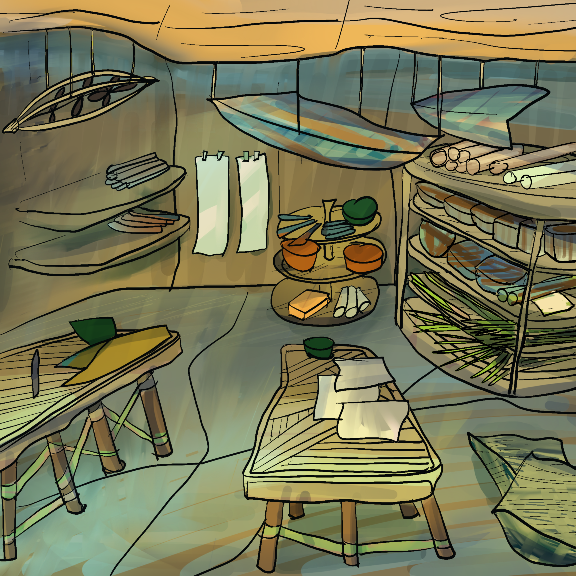
A workroom setting in my novel. Illustration by the author

I’m writing a YA fantasy novel! I had the idea in late 2019 and I started it in earnest in 2020. I wanted to write a story about a girl growing by the edge of magical wilderness, in an egalitarian, pre-agricultural society.

It’s become a slow burn project because I keep getting blown off-track by flurries of activity for other shorter projects.

It’s also taken a while because I’m learning a lot of writing craft along the way, and sometimes the breaks give the new concepts time to sink in. Like learning how to structure a scene, and add just enough new information and surprises to keep it interesting.

I wrote the novel’s “origin story” of how I started writing it here: (parts #1#2#3, and #4).

I also made a video series about a particularly productive novel-writing period, where I used drawing to get me unstuck.

I love leaning on strengths from my other interests, like art and research to find unique ways to approach this area. I draw to help visualize. I read news and history to inspire little plot details. And I love a good math metaphor to understand an idea in my magic system.

This is also one of the biggest projects I’ve done, and it’s taught me a lot about managing long-term projects that’s transferred to other areas of my work. Writing is an unpredictable process, and novelists learn quickly to work with that in their planning. An important lesson for me, since all my projects are unpredictable. I’ve learned from writing that I can handle that just fine!

Also appears: Medium, LinkedIn

Here’s my worksheet resource for having a deeply creative work session!

About My Climate and Sustainability Research

Summarizing all my projects in one place

I must have always loved animals, because I don’t remember ever starting to. Bugs, crows, frogs, and the rhinos on the nature programs on TV — I relate to them all. This interest in wildlife quickly led me to conservation, and climate change because, well, my animal peers couldn’t vote*, so I would.

[* or can they?]

But it wasn’t till 2021 that I dove into climate and sustainability research in a big way, and longer still till I found my voice writing about it.

Until then, I’d been studying engineering subjects tangentially related to climate, such as spacecraft that could be used for climate, how renewable energy sources worked, etc.

I felt like I didn’t know the terminology that was used in environmental circles. Climate is such an interesting cross-cutting problem that you need multiple approaches to really understand it — from the lenses of atmospheric science, ecology, technology, economics, policy and regulation…

Each with its own concepts, terms, and history.

So, I set myself structured reading projects, each about 3 months long, with a specific reading list. I made blog updates as I worked my way through, if you want to see how I did it.

Here’s the first one I did in Jan-Mar 2022 (setup, day 1, days 2–3, days 3–6, recap), where I got started with the basics, by reading the science and policy reports that were in the news at the time. It got me familiar with the types of language used.

For the second project (research lineup, days 1–2, multi-project update 1, day 3, day 4, day 5, multi-project update 2), I read another batch of reports, going a little broader from what I’d just learned.

For the third, I experimented with advocacy methods (public comments, letters to the editor, city council meetings, multiproject update).

Since then, climate action has become a much bigger and ongoing part of my life, and research just fits in with the rest. I don’t do these structured reading projects any more, but I still write about interesting tidbits I find in my Research Dispatch series. And I have a roundup of climate news over here.

Two years into my research quest, I gave a TEDx talk about climate change! It was a crystallization of everything I was learning, and an exciting, creative experience.

I believe finding our voices and bringing them to the climate movement is an important way to contribute. And if I can do it, you can too!

Also appears: Medium, LinkedIn

Here’s my free resource to overcome overwhelm and find clarity on YOUR personalized next step to protect the environment.