Blog

10 Awesome Things That Happened When I Drew Plants for 10 Days in a Row


My 10-day digital line art challenge

I was craving art time after a particularly busy (and analytical) period, so I decided I’d make digital plant art for 10 days in a row.

When I made the decision, I’d already been drawing a few plants in the style I planned. The change would be to do the drawings consecutively, as part of a 10-day challenge.

Additionally, I would screen-record my drawing process and post it on YouTube each day. So, this 10-day challenge was also the launch of my YouTube channel.

I jumped in without too much planning, beyond shelving my other projects to make time, and looking around to make sure I had approximately 10 plants available to draw.

From there, I basically took it day by day.

Looking back, it was a decided success! Here are the 10 awesome things that came from it.

1. I was able to quickly develop and hone a new art style

When I started this challenge, I had just begun experimenting with a new vector line art style* that was quite different from any of my past work. I was excited to see where I could take it.

By drawing in this style for 10 days in a row, I was able to improve on it from day to day, and let it sink into muscle memory.

Since doing the challenge, the style has become one of my staples for digital art. I can now dip back into it easily because it’s so well-practiced.

* In the iPad app, Vectornator. My review of the app is that it’s pretty decent and I continue to use it. Sometimes their updates make features worse. But I still enjoy the core functionality and feel of the lines. (Not sponsored.)

2. I learned what it’s like to satisfy the art craving

Generally, it’s hard for me to find enough time to do all the art I want to do, between my other projects and hobbies. I usually cycle between projects, making sure to come back to art often enough to feel balanced.

Even so, I frequently end an art session wishing I could do more, but other projects demand my attention.

In contrast, these 10 days of drawing were just the right amount of art-time. I wasn’t sick of drawing at the end, just pleasantly tired and pleased with all the work I’d done.

The experience showed me what it was like to fully satisfy the art craving when it arises, and to move onto other pursuits not because I have to, but because I’m actually in the mood to.

Now, I know what to aim for when I make space in my schedule for an art series. There is such a thing as ‘enough’ art time! (Until the next craving, of course.)

3. I got a clearer intuition on how long an illustration takes

Along the lines of the previous point, it’s hard to anticipate how long a drawing will take, and that can be a barrier to getting started.

I don’t have a great sense of time in general, and I lose track of the clock completely when I’m absorbed in art work.

Since this challenge involved screen-recording myself drawing, I could just look back at the video length to know how long it took. And since I did that for 10 days in a row, I got a sense of the average time I need to finish an illustration. It came out to 40–50 minutes for this type of illustration.

Having this foreknowledge meant I could start a drawing even in the middle of the day, with a full schedule ahead. It’s safer to dive into an art session with the reassurance that you will resurface within an hour!

4. I completed a cohesive illustration series in a short time

After the 10 days, it was satisfying to look back on the series of drawings I’d made. Better still, I could now use them in my other content.

In the months after the challenge,

  • I used my drawings as feature images in blog posts.
  • I turned a few of them into wall art for my apartment.
  • I put them in my portfolio and in galleries on my website.
  • I offered them to subscribers as a freebie in the form of an art book.

I can do that with any of my art, of course. But for me, this was an unusually rapid and efficient way to make an illustration series.

5. I got over the hump of setting up my YouTube channel

I’d been meaning to make a YouTube channel for a while, but this challenge (and the excitement on the first day) got me over the hump of setting it up.

On Day 1, I got my personal YouTube channel ready for the public by deleting old comments, archiving old videos, adding a profile photo, etc. None of this took long, and I didn’t overthink it because I was eager to get to the drawing challenge.

I also raced through the set-up steps of making the videos. I installed video editing software, made (rather bad) title cards, and collected royalty-free music to use in record time.

The process of editing and uploading videos felt unfamiliar and difficult on the first day, but by day 4, it was a piece of cake. Cramming the learning curve into a short time made it easier to get past.

I also learned, for future reference, that it takes me about an hour to edit and publish these videos.

6. I solidified my YouTube channel’s niche and tone

The tone, music, and visuals I chose for my plant videos were quite different from my other platforms — lighter and more cheerful. It felt odd and unlike me at first, but much less so by the last day!

I was able to confirm that — yes, I do like posting this type of video (called ‘speedpaints’), and I’d like to continue to go in that direction.

And I got past the stage of having an empty-looking channel. With 10 videos on there, it looked mature and ready to show to people.

7. I felt like I was really seeing my plants for the first time

Something happens to me when I draw consistently. It changes the way I see. Colors and details pop more, and I appreciate more of the beauty around me.

That goes double for when I draw nature, by deepening my connection to the Earth and living things.

I’m often grumpy when I can’t get out to natural spaces for hikes. Looking carefully at the plants near me was a good reminder that you’re never cut off from nature, even indoors, if you look for it.

I ended the challenge feeling much calmer and appreciative of my surroundings. Even in the mood to try some interior decorating.

8. I learned about how I like to work

The success of this project got me thinking about structure — how much I need, and how much is too much.

In the past, I’ve worked completely free-form, with hardly any structure at all. I thought this is what I preferred. But it made it hard to finish things, which was frustrating.

At other times, when I’ve tried to create rigid daily habits or follow public challenges like NaNoWriMo, the structure completely cramped my style.

I need to be able to flow between projects (and areas) according to my natural rhythm. That means, if I’m going to do the same activity every day, it needs to be for a short time.

For a lot of people, 10 days isn’t a long challenge. Thirty or hundred-day challenges are more common. But for me, it was the perfect length.

This challenge demonstrated that I can create structures that support my particular work style.

9. I gained insights about 10-day challenges, specifically

This wasn’t my first 10-day challenge, but it was my first successful one. There are a few things I did differently this time that made it work, and convinced me to keep using this format in future.

The first thing was that I didn’t just draw everyday — I published every day. Each day of the challenge created a completed piece, and there was no follow up needed.

In the first 10-day challenge I did, I wrote a response to a writing prompt every day, but I didn’t publish. While I did succeed at keeping it up for 10 days and I got a lot of writing practice, I still haven’t edited and published any of those pieces, as of time of writing. It’s been over two years since I did that challenge.

In contrast, this time around, when I got to the end of the 10 days, I was done. I’d succeeded. There was nothing more needed to complete the project.

That was important, because I was tired and ready to do something new! I didn’t want the challenge to create more work for myself at the end.

Also, by repeating the full publishing process so many times in a row, I had ingrained every step in memory. Even now, I am comfortable making a full video in a few hours because of all the practice.

10. I built confidence in my ability to follow through

Until the last day of the challenge, I was in suspense as to whether I’d actually do 10 consecutive days! When I got to the end with an unbroken streak, it was a huge confidence boost.

As I’ve mentioned, structured projects haven’t always gone well for me. And even when I do finish them as planned, they don’t always have the effect I hoped for.

Not so with this one!

I’d learned a new skill, launched a YouTube channel, and done what I said I’d do.

All reasons to believe I could do it again!


So, those were the 10 amazing things that happened when I drew plants for 10 days in a row.

If you are thinking of doing a self-imposed creative challenge, I can’t recommend it enough. Remember to tailor it to your particular work style, and make it just difficult enough to be exciting! I find that even a challenge that doesn’t push me to my limits is still helpful, since it provides consistency I don’t otherwise have.

And if you are curious or want to replicate this challenge yourself, you can see all the updates I made along the way here: (beginningupdate 1update 2galleryYouTube playlist).

Here’s my worksheet resource for having a deeply creative work session!
Originally posted in Share Your Creativity.

On World Refill Day 2023, Let’s Strategize

It’s on Friday, June 16th.

Photo by Nik on Unsplash

I learned recently that this Friday is World Refill Day.

We can all use the day being on the calendar as a reason to think and talk about refillable containers. Preventing pollution from disposable packaging is a worthy problem, and thinking about it at the same time makes climate action more effective.

Let’s take the opportunity to strategize. We’ll need to in order to build a habit and culture of using reusable containers (for carrying water to drink, buying coffee, and taking to bulk stores to fill with food or cleaning products).

We need to work against the typical hurried lifestyle that society pushes us toward.

As we experiment with the habit of carrying our own containers around, we can identify the snags that get in our way and problem-solve around them. And better yet, share our findings with others who are trying the same thing.

Here are some prompts for you to reflect on how to make reusables a bigger part of all our lives.

Figure out your reusable container logistics

As I wrote in How Do We Increase Adoption of Reusable Coffee Cups?

Let’s think through the logistics of having a reusable mug handy when you need it. There are a few different actions you would need to add to your day:

– (Remember to) pack your cup before heading out for coffee.

– Ask the barista to serve the coffee in your own cup.

– (Remember to) bring your cup back in the house.

– Put the cup into your dishwashing workflow (either the dishwasher or hand-washing).

– (Literally) rinse and repeat.

These actions can become part of your routine if you identify cues for or schedule each of these steps into your week.

Find stores that will refill your container

You can look up package-free stores for food or supplies near you that let you bring and refill your own container with their goods.

The keywords to look for are “package free,” “bulk,” and “zero waste” stores. Your local farmer’s market may also be a good place to buy package free.

I found one guide to package free stores for California: https://www.litterless.com/bulk-food-guide/california. There may be a similar guide for where you live.

If you work at a store or have an ‘in’ to talk to someone who manages one, think about what they can do to make it easier for bulk buyers! Or avoid supporting disposable products in other ways.

When it comes to improving the bulk-buying workflow, and the store itself is where the most leverage is.

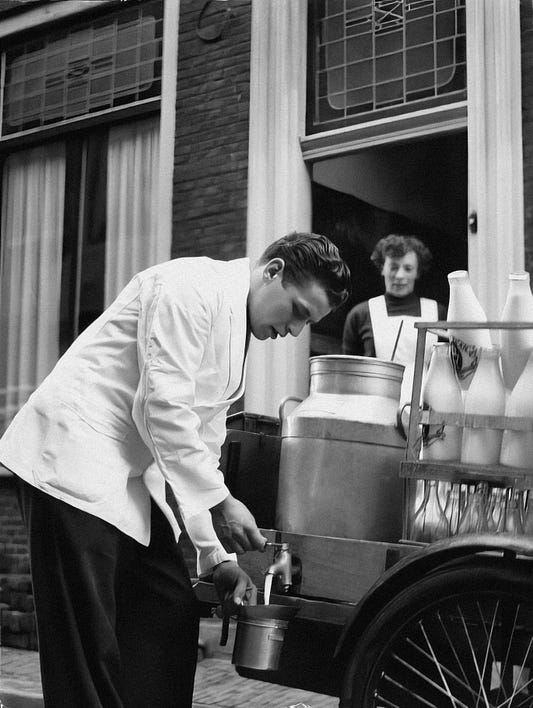
Photo by Nationaal Archief on Unsplash. Refillable used to be the default. It’ll look different now, but maybe it can be again.

Remember why

Using refillable containers is part of the larger sustainable idea of using less material overall, by making products more durable and getting more use out of them.

An individual refillable container usually takes more resources to make and has a higher carbon footprint than an individual disposable container, so the advantage comes from being reused. (Not just reusable.)

Having just a few containers and using them for approximately a lifetime is the trick to getting the environmental benefits of less resource use over time and preventing plastic pollution.

So, this can be a tough one, but resist the urge to go out and buy snazzy new mugs, containers, and tote bags, unless you absolutely need them.

Sadly, the way eco-friendly products are marketed can lead us to assume the solution for a bad product is to buy a better product. But in this case, the solution is to buy fewer products.

Which leads me to…

Mend or repurpose something

What are some ways you can get more life out of a product you already have?

Earlier this year, I busted out my sewing kit for the first time and mended a backpack.

A section near the zipper was fraying to shreds, leaving a yawning gap. I’d gotten my fingers tangled in the strands trying to get something often enough to sit down on the carpet, stream a mystery series, and make a project of it.

Photo by the author. The gray strip is some lining I used as an attachment point. Hope it lasts.

I did a pretty rough job, having no sewing experience, but it held together when I took it on a trip! And, boy, did I feel cool. Cottagecore, self-sufficient, and all that good stuff.

Do you have a product you can fix or turn into a functional container? Or something you could decorate to make exciting to use again?

That’s a chance for a potentially fun activity as well as a product. And feeling accomplished.


Using refillable containers takes foresight, and it’s understandable that it doesn’t feel natural to many.

Seconds before running out for errands isn’t the best moment to figure out what container to take.

Instead, let’s take a moment to step back and think strategically, so we make the decision easier in the moment. World Refill Day might be the reminder we need to do that.

Also appears: Medium

About Social Tipping Points and Climate Action

DEEPTI’S RESEARCH DISPATCH


Also known as phase transitions and critical mass. A research roundup

Photo by erin mckenna on Unsplash

Social tipping points are the mechanism by which social change spreads and sparks transformation. In my writing, I frequently talk about social tipping points toward climate action as a goal to aim for.

Here, I dive deeper into the concept of tipping points and its connection to social change with a tour of the research I’ve collected.

I’m hoping this will be a useful reference to come back to whenever discussions of the topic arise.

What are tipping points?

A tipping point is the colloquial term for a phase transition, or the phenomenon where incremental changes in a system reach a critical threshold, leading to rapid transformation.

You may have heard of tipping points from Malcolm Gladwell’s book, The Tipping Point.

This phenomenon goes by many names, since it’s seen in many parts of the natural world, including changing phases of matter, nuclear fission (where the term ‘critical mass’ comes from), ecological shifts, swarm behavior of insects, epidemics, and the rise and fall of societies.

Going forward, I will use the term ‘phase transition’ most of the time.

Phase transitions in everyday life

Phase transitions are a common mental model in popular culture for situation where we keep applying effort, but we don’t see the results until all the pieces click into place.

This blog post on Farnam Street has a good roundup of writing on the concept, and explains:

As a mental model, critical mass can help us to understand the world around us by letting us spot changes before they occur, make sense of tumultuous times, and even gain insight into our own behaviors. A firm understanding can also give us an edge in launching products, changing habits, and choosing investments.

In Atomic Habits, James Clear uses the metaphor of incremental temperature change and the melting of ice to describe habit change.

Writings on technologymanagement, and world peace also use the concept.

How are phase transitions modeled?

The natural examples of phase transitions I mentioned (matter, nuclear reactions, viruses) above involve systems with individual units or ‘agents’. Observations of these systems show evidence of the phase transitions behavior.

Scientists have also developed a variety of agent-based and equation-based mathematical models and simulations to explain the mechanism behind the observed behaviors of the systems.

These models can be run with various adjustments to their parameters to see how they affect the phase transition.

Why does the concept apply to social change?

Often, the models of ‘agents’ in a system are fairly simple. Societies, on the other hand, are made up of humans who are famously impossible to predict or model accurately.

Still, we can extract useful qualitative insights about collective behavior even from simple model.

This is a long ‘un! You can read the rest on Medium (you don’t need to have a Medium subscription).

* * *

Understanding phase transitions has completely revolutionized my approach to climate action.

I constantly think about how my participation connects to a wider dynamic, and that helps me be both more strategic and more hopeful.

Here’s my free resource to overcome overwhelm and find clarity on YOUR personalized next step to protect the environment.

Also appears: LinkedIn

About My Creative Process

If you’ve looked around this blog, you can probably tell I have a ton of interests and projects! The main areas I like to work in are art, research, fiction, nonfiction, and, of course, climate.

I’m usually working on a handful of projects in parallel, and bounce between them as inspiration strikes. Inspiration can be unpredictable, which is a challenge when it comes to planning ahead. 

The two terms that, combined, best describe the way I work are ‘multipotentialite’ and “methodological-pantser.” The first refers to having many different interests. The second term comes from a categorization by novel editor Ellen Brock, extending the plotter/pantser dichotomy to more dimensions. It means that I like using systems and methodology in the short term, but in the long term, I’m winging it.

Put together, those traits result in a pretty chaotic way of working! (Well, I like it. Never a dull moment.)

So, it’s been important for me to figure out how to be organized and maintain continuity on projects that progress in fits and starts. I cycle between projects in short bursts, and I need to be able to capture everything I need and pick them up easily.

Identifying my work style was a huge step up, creatively. Being organized and planning don’t come naturally to me, which is why they’re often on my mind. I write about my creative process while I figure it out, in the spirit of showing the behind-the-scenes (and pushing back against one-size-fits-all productivity advice). 

I’ve been experimenting with organizing my work into short series or art challenges (10 days, month-long), which worked amazingly well

I also make tools and worksheets for myself. And for you, if you are someone who works a bit like I do. And if not, hopefully, my process is interesting as a data point to consider as you discover what does work for you.

Also appears: Medium, LinkedIn

How Do We Increase Adoption of Reusable Coffee Cups?

I’ve been curious about the logistics of reusable coffee cups, since they are a good case study for sustainability in the food industry. (And I love coffee. And mugs.)

Grabbing a quick coffee on the go is ingrained in a lot of people’s lifestyles. What would it take to modify this habit to eliminate waste from the use of disposable cups?

In this post, I’m approaching the question from the point of view of a designer. We can make changes for ourselves, but to really make a dent in the waste problem, we need to increase the overall adoption rate of the changes. 

As I wrote in my recent piece on time poverty, we need to design sustainable behaviors while taking into account everyone’s constraints, including the busiest among us.

Below, I go into the research to get our wheels turning on this design problem.

Bringing your own cup

Customers bringing their own reusable cups is one readily available option to reduce waste. With a few lifestyle adjustments on our part, it can become second nature.

Let’s think through the logistics of having a reusable mug handy when you need it. There are a few different actions you would need to add to your day:

  1. (Remember to) pack your cup before heading out for coffee.
  2. Ask the barista to serve the coffee in your own cup.
  3. (Remember to) bring your cup back in the house.
  4. Put the cup into your dishwashing workflow (either the dishwasher or hand-washing).
  5. (Literally) rinse and repeat.

These actions can become part of your routine if you identify cues for or schedule each of these steps into your week.

One question to consider here is how many reusable cups you will need. Naturally, it depends on how often you do your dishes. If you run your dishwasher a few times a week, you’ll need enough cups to last till the next run.

The environmental tradeoffs work in our favor if we maximize the number of times we use our mugs. This article in Anthropocene Magazine explains why:

Indeed, only with frequent use can one decrease the potential impacts of the reusable cup; it would take between 20 (human health category for a polypropylene travel mug) and more than 1,000 (ecosystem-quality category for all travel mugs) uses, depending on the cup/mug type and the environmental indicator, to make up for the impacts of a single-use cup. If a reusable cup is used fewer times than that, the single-use cup is better for the environment.

What should we do then? Can we help the environment? The answer is yes: by reusing your cup for several years and by limiting the quantity of soap and hot water for washing it, the reusable cup should be the way to go. Limiting your coffee intake could also be something to look at, but that is another problem altogether.

Washing the cups efficiently is important. Here are some estimates around the effects on water use:

Water Footprint Calculator has estimates for the amount of water used in hand washing vs dishwashers for a load of dishes.

Hand washing one load of dishes can use 20 gallons of water, whereas water- and energy-efficient dishwaters use as little as 4 gallons.

…and this Guardian article has estimates for the amount of water used in making disposable cups.

[…] it takes water to brew the coffee (0.05 litres), but even more to make the plastic lid (2.5 litres) as well as the paper cup and sleeve (5.6 litres).

Let’s do some back-of-the-envelope calculations to compare the water use of reusable cups vs. disposable cups, per drink. Since I’m calculating ‘per drink’, I’m not factoring in the water used to make a reusable cup. I’m assuming you will reuse the cup often enough for it not to matter.

Say you drink 5 cups of coffee a week. The quote above means one disposable cup (with lid) takes 2.1 gallons of water to make, so the water use associated with the cups per week is 10.5 gallons.

With a reusable cups, I’m going to estimate how many more loads in the dishwasher you need because you added reusable cups to the mix. Let’s say you use five reusable cups a week. I think that’s about 1/6th of a dishwasher load (just eyeballing my own dishwasher, I think I could get at least 30 cups in there). So that’s an added weekly water use of 0.67 gallons per week.

Okay! So that was some fun math, and not terribly precise. But it validates that that having a few reusable mugs, using them for as long as possible, and washing them efficiently is a huge improvement on getting a disposable cup every time.

Changing the culture around to-go coffee

Bringing reusable cups has not caught on (yet). Research in the UK suggests that only 5% of hot drinks are sold in reusable cups brought by the customer (as described in this article from Circular Online). I would speculate that the numbers in the US are similar.

One of the challenges of bringing your own mug is that it requires time and thinking ahead. Unfortunately, these are often in short supply.

How did we get here?

I read up on the evolution of the to-go coffee cup and cultural environment that led to it, is as outlined in this fascinating article in Life and Thyme:

In America, we see the coffee cup as a symbol of the modern professional — the marker of a person on the go. We assert that we have no time to spare to sit with a steamy cup, but must take our jolt of caffeine on the road (or down the sidewalk, or up the elevator) to face the day full-force.

[…] In 1907, a Massachusetts lawyer Lawrence Luellen, invented the first disposable cup to stop the spread of germs from these communal cups. His invention, originally called the Health Kup, would develop into what we know as the dixie cup today.

[…] In 1952, the Pan American Coffee Bureau coined the term “coffee break.” This made official the practice that began in defense plants during the war, when tired workers needed a few minutes of rest and a caffeine jolt to make it through their long workdays.
[…]
 In 1964, 7-Elevens on Long Island became the first chain stores to offer to-go traveller cups. From there, commuter coffee culture proliferated as chain convenience stores across the country began to carry twenty-ounce behemoth to-go cups, usually as part of a loyalty discount “coffee club.” A 1989 New York Times article referred to this specific travel mug as a “plastic sloshproof wonder” for late-twentieth century commuters.

[…] Starbucks had to standardize their offerings for to-go cups and lids. The company chose the Solo Traveller, a lid designed specifically for drinking on the go. […] There would be no more tearing, pinching or peeling back plastic lids to get to coffee while walking or driving; the traveller lid was ergonomically designed to be sipped from while on the move.

It is like a history of American consumerism, car culture, and hustle culture in miniature!

I guess people reallly like the busy, on-the-go feel of grabbing coffee and power-walking down the street with a briefcase. It kind of goes with the caffeine.

This post from the High Country Conservation Center also points out that online and drive-thru orders, which may be a majority of coffee sales, don’t work with reusable cups.

Personally, I think increasing adoption of customer-brought reusable cups is important, but we shouldn’t count on getting to 100% adoption. According to this article in Bon Apetit:

Disposable coffee cups are here for good, says food historian Cory Bernat, who co-curated the Smithsonian National Museum of American History’s American Food & Wine History exhibits.

“When I look at food culture, it’s all about habit, and businesses have a lot more influence over our behaviors than we like to admit,” she says. “I see companies that are very quick to reassure people it’s OK to ask for convenience, and people who are very quick to accept that offer. People just want this thing out of their hands in the easiest way possible.”

There may always be a segment of the population that doesn’t carry a reusable cup. For them, we need to figure out alternatives. From the same Bon Apetit article:

On the other hand, [Matt] Fury of Think Coffee has emphasized compostability in his disposable coffee cups, with his stores using cups from U.K. firm Vegware, while encouraging people to bring in reusable cups.

“The future will be semi-reusable,” Fury says.

Even so, I’d urge that we do everything we can to normalize bringing your own cup, as well as slowing down in general. 

There are several trends already in this direction, as we grow less enamored of hustle culture in general. All we have to do is accelerate them.

Logistical changes at coffee shops

The coffee shop is where the highest leverage changes can happen. After all, they are the ones procuring all the disposable cups in the first place. They can decide whether to change that.

The first and most basic change that coffee shop managers should do is create a workflow to handle customers bringing their own cups, or requesting a ‘for here’ cup. 

In my experience, either of these requests seems to throw baristas for a loop, because their processes are not designed for it. Sometimes the instruction goes through multiple employees in written form, and there is no clear option to include these serving requests.

This is not these employees’ fault! (Please don’t hassle them about it if they get your order wrong. I shudder to imagine what it’s like to serve pre-caffeinated people in the morning.)

Whoever designs these workflows hasn’t thought through these eventualities, and it’s time they did.

Secondly, coffee shops need to replace all their to-go cups with compostable or recyclable options. Standard paper coffee cups are not recyclable because they are lined with plastic. This means that the second they are manufactured, they are destined for the landfill. They have no place in a sustainable economy.

These were the two most fundamental changes. And there are even more innovative options available…

Reusable cup swap schemes

These are schemes where reusable cups are interchangeable. You can buy your coffee in one cup, and return it at the same (or in some cases, different) coffee shop. Your order is served in one of the pre-washed cups they have on hand.

All the washing is done in efficient, industrial dishwashers. 

And it requires marginally less foresight than bringing your own cup — you can grab coffee on a whim, but you have to remember to bring the cup back eventually. Or you don’t, and the cup is yours and you lose the deposit. 

The main concern would be if people used these cups as if they were disposable. That is the worst of both worlds, because as we saw in the first section of this post, you need to use a cup about a 1000 times to get the environmental benefit. So cup swap schemes will still need some behavior change to go with it. Even so, I find the idea promising.

This Daily Grind post outlines the advantages:

“Our staff wash and sanitise the used cups and then place them back into the float, ready for the next customer,” he [Cyrus Hernstadt, Director of Communications at Think Coffee] tells me. “This saves customers from cleaning their reusable cup at home, as well as diverting a single-use cup from going to landfill.”

Although many customers do have their own reusable cups, visits to coffee shops are often spontaneous — meaning it’s easy for consumers to forget to bring them. What’s more, remembering to clean the cup can be a deterrent for some customers.

 […]

For baristas, reusable cup swap schemes can help to improve workflow. Instead of having to rinse out a customer’s own reusable cup, they can simply swap it for one of the coffee shop’s prewashed reusable cups.

As well as being more convenient for baristas, it’s also more hygienic.

HuskeeSwap helps to reduce the risk of cross-contamination because the cups are washed onsite to higher food safety standards, rather than being brought into the coffee shop from public transport, a car, or a bag,” Michael explains.

Furthermore, reusable cup swap initiatives are more convenient and accessible for many consumers — especially if they have forgotten to bring their own reusable cup and don’t want to use a disposable cup. In the case of HuskeeSwap, Cyrus explains that cups can be borrowed or stored through the app.

Temporary holding containers

The post from High Country Conservation Center mentions a clever workaround for online and drive-thru orders:

There’s also discussions [at Starbucks] of using temporary holding containers for pre-ordered beverages and then transferring to the customer’s own vessel at the drive-through window or at the counter for pre-orders as well as adding a window for customers to drop off mugs for filling at an earlier point in the drive-through process.

From a design perspective, I find these solutions modular and elegant. It just makes sense to me that there would be alternatives to throwing a cup away every single time you drink (an absurd idea if you think about it) that don’t shift all the work to the customer.


To eliminate the waste from disposable coffee cups, we’ll need a combination of approaches so that we cover all segments of coffee drinkers.

The most important changes happen at the coffee shops themselves. For us regular folks, there are multiple levers that might speed these changes along, including regulation and consumer pressure.

I’ve outlined all the research I found on the subject in the hope that it will spark ideas, whether you’re a customer, designer, coffee shop owner, or just someone who cares about the environment.

Here’s my worksheet resource for having a deeply creative work session!
Also appears: LinkedIn, Medium