I’m Giving This Planning Thing A Try

I’ve been an engineer for 6 years now. You might assume that being organized comes naturally. You’d be wrong.

I got into engineering because I love math and science. Math is like a way to see the world in a different lens, like being able to see more wavelengths, or having a new way to describe what you see, and find connections between seemingly disparate things.

In engineering, the math and analysis fit into a larger picture with many moving parts: teams working on different aspects of different modules, many stages of design and testing and manufacturing, and schedules to get through each phase, and funding that’s available for each phase. Those are factors that decide what math problems you get to work on and when, based on what is needed to get the project to the next phase.

All of that context dissolves when I get in front of the math problem. Then it’s just me, a page full of symbols, and the colors and geometrical shapes and curves in my mind.

I can’t ‘math’ my plans

Superficially, planning looks a bit like math and science. It’s a bit like modeling the process of making something, similar to how a scientist might model a chemical reaction or a geologic process. That similarity is what tripped me up.

Predicting what I’ll do tomorrow is not at all like a geologic process. It depends on more factors than can be modeled, including my energy state, whims, what other people I meet, the state of the economy and news, etc.

If one were to even try to model that (which I never would; the mere thought chills the blood), it would require massive amounts of information I don’t have. I’d have to know the state of every neuron and blood cell in my own body, and in every other person’s who might be on my team, every variable that governs the economy and what tasks my company assigns me, and so on. 

Even if one could collect all that information, it wouldn’t be enough. The system that governs your work life is what we’d call ‘chaotic’, meaning that its outcomes depend on the slightest change in one of those variables. Commonly known as the butterfly effect.

Anyway, that is an aside to say planning is not at all like modeling, but I wanted it to be. I would never guess or rely only on intuition when answering an engineering problem (though intuition plays a huge role), but that is all you can do when planning. You can collect data on how long things usually take, and try to be a bit more rigorous in predicting what might happen, but deep down, I knew my projections were based on guesswork, hope, and good-enough reasoning. And I hated it. It felt like lying.

Novel projects are great for planning practice

Novelists have it right. There are lots of resources on how to plan writing a book, but the essence of it is to divide the project into ‘drafts’ (first draft, second draft), estimate the length of your book, and then schedule out writing sessions over a few months with a word count target.

This process defines the basic unit of progress as ‘words’ and the only goal is to produce them, or revise sections of them. The ultimate goals of defining the story, solving plot problems, improving the prose, etc. are not official goals  –  they are too hard to quantify and too mysterious to plan. But the task of showing up and writing every day is enough to achieve all of them.

When I wrote the first draft of my novel, I made a spreadsheet word count tracker (which you can download here if you’d like to try it). I needed to customize it because I was writing in multiple documents for separate story threads, and needed to add all the word counts together. A pretty graph ticked up every day as I added words, and was motivation enough to keep going when the story seemed full of problems. Best of all, I had a sense of how much there was left to do in this draft – the number of words left to get to my target.

Now, just writing that number of words doesn’t make a draft complete. I considered the draft complete when I got to the end of the story since I already had an end in mind. But the word count correlates to that, since I had rough milestones in the story that were expected to occur at specific percentages of the book, so I could tell if I was running short or long depending on where the milestones hit. I ended up with a shorter draft than planned, but that doesn’t matter since the word count was just a metric for tracking. The story came, which is what really matters.

For subsequent drafts, I’ve been adapting the process even further. There isn’t as clear a metric of progress as there was in a first draft (discovery draft), since I jumped wildly from world-building, plotting, drafting, researching, and every other process.

I’m a ‘methodological pantser’ per  Ellen Brock’s categorization of writer styles, and figuring that out has been a game-changer.

(You may have heard of ‘plotters’ and ‘pantsers’ – Ellen expands this categorization to better capture the variety and specificity of writing styles. Methodological pantsers use a lot of systems and methodology, but we jump around from one to another as inspiration dictates.)

As a methodological pantser, I tend to switch between processes as needed. For each process, I figured out a unit of progress, like:

  • Number of entries added to my worldbuilding wiki.
  • Number of research materials read.
  • Number of words of brainstorming or tone experiments.

Those were the equivalent of my pretty word count graphs that told me how far I’d come. At the basic level, the planning unit was the same – writing sessions. The plan was simple. Sit down for ~20 minutes some 8 times a week. Each time, log the units of progress. Occasionally project forward to see how many more pages or references or chapters there are to go. The end.

Now I approach engineering (and all projects) like writing

The science and math and design of an engineering project tell me what is needed to be done. Write this piece of code, solve that equation, order such-and-such tool. The writing-inspired planning process tells me how to do it. Figure out the unit of progress (which is usually the number of discrete tasks left to get to the result)  – schedule out some sessions, work on the next task for 20 minutes or so, and log how far there is left to go.

This is a squishy, unpredictable, human process in the midst of a bunch of predictable and precise physical and mathematical processes. It always was, but at least now I’m letting it be true to its (my) squishy, unpredictable nature. Progress in a project is something you can only describe. You can’t model or predict it, and I don’t try to. Improving my ability to understand what I’m doing and how far I am from my goal has made a huge difference, not least because I can ‘feel’ the progress even when I’m stuck and the symbols blur together on the screen.

Engineering and science were always a creative endeavor of inquiry, and approaching them like a novelist is the best way to embrace that.

Research Day 1: Skimming the Longest Tomes

I’m starting by skimming the longer reports I’ve chosen for the quarter. I’m doing this to give myself a teaser of what to expect and estimate how long each report will take to read.

For the longer documents, I’m giving myself two weeks to read and annotate each of them. For the shorter documents, a week should suffice. I’m not typically reading these cover-to-cover as if they were novels. Rather, I’m familiarizing myself with useful information that I can come back to, and identifying more directions to pursue.

Here are the questions I’m asking myself while I’m skimming:

  • What is the document, in simple terms?
  • When is it from?
  • What type of language does it use – legalese, engineering-speak, or layman-friendly?
  • What am I looking for in this document?
  • How many (readable) pages is it, excluding appendices and references?
  • What cited resources do I want to add to my TBR (‘to be read’ as the Booktubers say)?

The links to all the reports are in the post I wrote defining the project.

UNEP Emissions Gap Report

What it is: An assessment of climate mitigations pledged, implemented, and the gap that needs to be covered to limit warming to 1.5 deg or 2 deg C.

When it’s from: October 2021.

What type of language it uses: Policy, economics, and science.

What I’m looking for: I want to know the main areas of potential improvement. I have questions like: what is needed in each sector? How much investment is there already? How can I (we) participate in these improvements, through our jobs, volunteer work, personal lives, communication, or lifestyle?

Number of readable pages: 63, excluding the references, since I don’t usually ‘read’ the references section. I just ‘refer’ to them.

Citation I’m adding to my TBR: September 2021 NDC Synthesis Report by UNFCCC.

Taking Stock 2021

What it is: An assessment of what US greenhouse gas emission trends are expected to look like, based on current federal and state policy made by a think tank called the Rhodium Group.

When it’s from: July 2021.

Type of language used: Mostly economics-related, but it seems pretty layman-friendly. (Which is good. I don’t know much economics yet.)

What I’m looking for: What is driving emissions in each sector? (And what can I and we do about it?)

Ooh. The section ‘Drilling Deeper: Key trends by sector’ – that’s what I want to know.

Number of readable pages (main): 15, excluding the Technical Appendix starts on page 15. I may refer to the Technical Appendix if I have questions, but I won’t read it in the traditional sense.

2021 Aviation Climate Action Plan

What it is: A policy framework for the aviation sector to become more sustainable, released by the Biden Administration.

When it’s from: November 2021.

Types of language used: Engineering, economics, policy.

What I’m looking for: Answers to questions like:

  • What are the key enabling technologies for sustainable aviation?
  • What can we do to influence this?

Number of readable pages: 35, excluding the glossary.

Coming up

So that’s my skim of the biggest reports on my list! Next, I’ll skim the smaller links. Then I’ll be ready to get into the first big report in detail.

A Belated Multi-Project Update – Fantastical Research Quest

What projects am I working on in February 2022?

Sustainability Research

I’ve been learning about sustainability since about 2018, and gradually picking up speed. In the term ‘sustainability’ I include related topics like climate change, environmentalism, and green technology.

Combined, they are a vast web of topics and it’s been difficult to know where to start. Last year, I took a bunch of climate-related online courses (the first three were free or take optional donations):

… and that gave me a much better overall grasp of what I needed to learn in the first place. I’d recommend them all, but the first one especially, if you’re new to the subject. (I have no affiliation to any company or brand linked in this post.)

This quarter (January-March 2022) is the first time I’ve set myself a clearly-defined research project in this area, with a reading list and a deadline. I’m hoping that will help me make more regular progress.

I haven’t been doing a great job of documenting my progress thus far, and I want that to change. I’ve been collecting all my research updates here.  I’m also doing a revamp on this website – I want to turn it into more of a comprehensive resource wiki, where you can look up any topic or question about sustainability that I’ve ever researched.

My YA Fantasy Novel

I started the novel back in 2020, when an idea for a protagonist, setting, and magic system hit me all at once out of nowhere. I picked it up again in December 2021 after a lull where I was still figuring out my writing process. I post novel updates here.

I haven’t shared any details about the novel yet, and I’d like to start breaking the cone of silence this quarter.

Art

Lastly, my painting isn’t quite a project the way I define it (something with goals and parameters, and occasionally a deadline). Painting is more of a practice I do to restore myself and enjoy my surroundings. However, I am listing my painting portfolio as a project that I update here.

* * *

So those are my projects for the quarter, and it’s a far more structured list than usual. I intend to document the journey here on the blog.

Below, I’ll comment on some questions you may have (or rather, that I ask myself constantly).

Why am I doing so many different things at once?

While working on fiction, nonfiction, and art at once goes against the conventional wisdom that you must pick ONE project for a period of your life, after a bit of experimentation, I’ve found that this is what works for me. I’ve done the thing where I’d be ‘just’ one thing for three months or a year or a season. It turns out to make me miserable, sort of like if you decided to only eat one food group for a whole year.

I’m not suggesting that this is ‘the’ correct way to do it, but it is ‘a’ correct way for me. I’m what they call a ‘multipotentialite’ – also referred to by various terms: Renaissance (wo)man, polymath, Scanner. They have different connotations some times (the first two especially are commonly applied to famous dead people) but I use them to mean ‘someone seriously pursuing multiple interests’.

Any notion of ‘ONE project at a time’ does NOT help me, but rather, one project per area of life.

What novel draft am I on?

Knowing how I like to work has been a huge improvement and an ever-evolving process of discovery. On the fiction front, an insight that changed how I approach writing (and all projects) was Ellen Brock’s categorization of writer styles.

You may have heard of ‘plotters’ and ‘pantsers’ – Ellen expands this categorization to better capture the variety and specificity of writing styles. Per her system, I identify most as a ‘methodological pantser’ – one of the most chaotic styles. We use a lot of systems and methodology, but we jump around from one to another as inspiration dictates.

Learning this has shown me that rather than try to pre-decide what aspect of a novel (or other project) I’ll work on, I need to instead capture ideas as they come, in the order they come in, and then organize them into a useful form. Imposing a small amount of structure on what I pursue is beneficial, but just enough. 

All this to say, I’m not sure what draft I’m on because there isn’t a clear demarcation between drafts. I spent most of December 2021 on worldbuilding. Now, in February, I’m drafting in earnest. If pressed, I’d tentatively say I’m on the 2nd draft.

How do I keep track of and break down these projects?

I’m essentially following Sarra Cannon’s HB90 method, with a few tweaks. I use Notion to track most of my project tasks in Kanban boards. I also have a ton of notebooks. I like to use notebooks for coming up with ideas and writing stories. I prefer to do most of my project planning and tracking in digital form.

I’ll expand on my process of planning and tracking for the research and novel projects by and by. I don’t intend that to be a teaching resource or tutorial – I’ll link the ones I’m learning from, but I’m not an expert at it – but rather just another aspect of the research quest to document.

My Sustainability Research Lineup For Q1

I’m told it’s 2022 already (what! it’s FEBRUARY?), and I’m planning a major push to catch up on my climate change education.

Though I’ve been interested in environmental matters since childhood, I only started trying to stay informed about the climate space recently. I want to build a strong foundation from scratch and learn all the relevant concepts, news developments, and terminology.

Words and phrases like Paris Agreement, Green New Deal, and COP26 go by in the headlines, I do my best to keep up with the developments, but I also like to go deeper after the fact. Reading the original agreements and reports can be fun because:

A] It makes me feel cool.

B] I’m looking for opportunities to get involved, and I want to know what initiatives are likely to come down the pike.

C] I want the complete picture, not just the parts that get the most circulation.

Here is where I’m collecting the past research I’ve done related to climate change and sustainability.

I have a huge stack of reports I want to get through, all downloaded onto my tablet and ready to mark up, and newer reports keep coming out as soon as I’m about to catch up! So the next couple of months are going to be a big push.

How I’m Accelerating my Research Process

The main improvement I’m making is to plan out my research a bit more.

First I selected the documents I’d like to read.

  1. The UNEP Gap report, which was mentioned in a lot of the COP26 coverage I read. (If you are wondering what COP26 is, it was a UN meeting regarding climate change that occurred in November 2021. I wrote about it here.) It outlines how far short we are currently falling in meeting our climate targets.
  2. The initiatives that came out of COP26.
  3. The Taking Stock 2021 report, which assesses the outlook for US greenhouse gas emissions each year.
  4. An HBR article about supply chain transparency
  5. The 2015 Paris Agreement, which I read once, but haven’t written much about yet.
  6. The Green New Deal, a bill introduced by Rep. Ocasio-Cortez in 2019 – mostly as a history lesson, since it was not adopted.
  7. The US 2021 Aviation Climate Action Plan. Another document that came out of COP26.

I selected these because:

  • I want a big picture understanding of what precisely needs to be done. A part of that is understanding the current status.
  • I’m trying to give myself a crash course in the history of climate change policy. What did I miss?
  • I’m looking for tech roadmaps that speak to a coherent strategy on what needs to be developed. Then I (or you) can work on some of enabling initiatives and know we are moving the needle. The aviation action plan is the first sector-wide action plan I’ve seen. I hope to find similar plans for every sector.

As you can probably tell, I like to have a big picture understanding of things and start with an overview so I have all the information I need to make decisions. This preference also affects how I’m planning out this research project. 

The steps I’m going through are:

  • Skimming all the reports and summarizing their purpose. Also estimating how long each will take to read
  • Prioritizing the reports and scheduling out 25-minute sessions to read them.
  • Sharing the research dispatches on individual documents as I go. Some documents may need multiple summaries.

I’m not a naturally organized person, but I have been planning out my projects in Kanban boards out of necessity. My previous approach to research was to jump from obsession to obsession. So this new approach is an experiment.

More updates to come, and if you’re catching up on your climate change education too, I invite you to follow along!

How to Have A Deeply Creative Work Session

.

For a while, I was having a hard time getting into my projects. I postponed working on my fantasy novel. I was scared to pick up my math problems or environmental research. My creative projects were usually my biggest source of joy and fun, so it took me a while to figure out why I didn’t want to work on them.

An obvious clue was that the rest of my life was a bit chaotic. Mid-pandemic blues had me neglecting housework. My files were in disarray and my backlog of errands filled pages and pages of my bullet journal.

Here is a comic I made at the time, poking fun at the situation:

Trying to laugh through the tears…

However, this situation wasn’t new. I haven’t been a stickler for organization, and usually, jumping into a project was my avoidance-tactic of choice. The housework and other errands managed to get done in erratic binges, and a rocky equilibrium was maintained.

What was different about this time was that the chaos was getting to me. And I knew I had to stay in the real world to sort it out. I couldn’t jump into Creative World without letting the situation back home get worse.

All the reading about the Hero’s Journey for my novel got me thinking about my creative projects as their own world that I projected into, sort of like the Spirit World in Avatar the Last Airbender. (I feel compelled to add that I was into ATLA before it got on Netflix and everyone started talking about it.)

In that show, your consciousness wanders the Spirit World while your body sits still without you. So you need to find safe circumstances to sit down and meditate, before you go exploring other worlds.

This is exactly what I was finding harder and harder to do.

The first problem was getting INTO Creative World, because my regular world was in chaos. I was scared I’d come back to a pile of overdue bills, an empty fridge, and missed appointments.

My second problem was that when I DID get in, I got stuck. I’m prone to hyper-focus, and since I visited Creative World so rarely, when I got there, I tried to do EVERYTHING. And I’d stay in for hours and hours, unable to pay attention to anything else. (And of course, those absences increased the disruption in my regular world.)

And lastly, since I was leaving long gaps between sessions on my project, I completely lost the thread each time I left. I’d steel myself to work on my novel, only to find I’d forgotten the story and had to read my notes as if they were someone else’s (if I could even find them).

The imagery of a portal to a separate world was stuck in my head. And solutions started to come into view as well – what could I do to make the entry easier, by first securing the premises in my regular world and getting organized?

A desk next to a colorful portal. On the desk, a list says "First eat. Meeting tonight. Remember to buy carrots."
Reminding myself what to do when I come back

Could I leave myself a map to get around the Creative world once there?

Leaving breadcrumbs for myself each time I visit Creative World.

And could I make the return smoother and less disorienting, by NOT doing that dumb thing I do: rushing to get to the next task without getting my bearings?

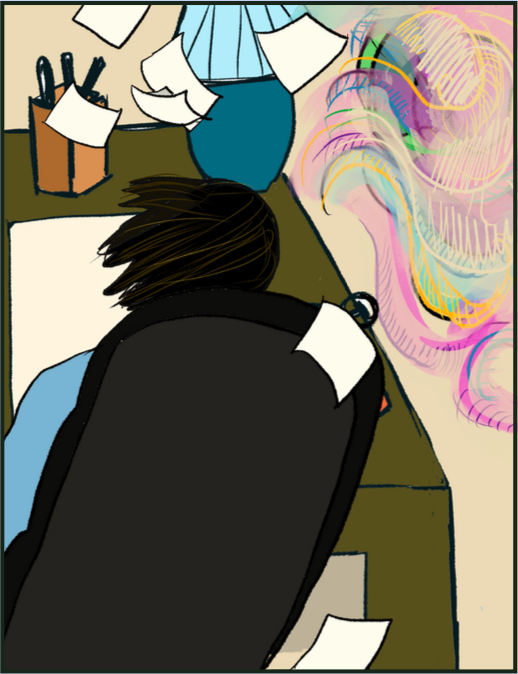
A person sits at a desk. A faded portal on their right. Wind whips the person's hair and blows papers around the room
I’m back! What just happened?! Am I late for something? Run, run, run!

I found specific tweaks I could make.

  • A checklist for constraints and urgent matters to get out of the way before jumping through the portal.
  • A log tracking what I did on the project each time, what needed to be done next, and where the work was stored.
  • Consciously taking a moment to rest when I was done with a creative session.

It’s helped enormously. I’m finally working steadily on my novel and a giant (years-long) math project, after months of being too intimidated to touch them. I’m about a third of the way through my novel’s second draft now.

This framing has changed the way I think about how to be creative and prompted ideas for more tools I can develop specifically for each stage of a creative session – entering the portal, navigating Creative World, and the transition back to the regular world.

Want a fun resource, in the form of a fillable comic that will guide you through this process for your own creative projects?

.