Blog
My Sustainability Research Lineup For Q1
I’m told it’s 2022 already (what! it’s FEBRUARY?), and I’m planning a major push to catch up on my climate change education.
Though I’ve been interested in environmental matters since childhood, I only started trying to stay informed about the climate space recently. I want to build a strong foundation from scratch and learn all the relevant concepts, news developments, and terminology.
Words and phrases like Paris Agreement, Green New Deal, and COP26 go by in the headlines, I do my best to keep up with the developments, but I also like to go deeper after the fact. Reading the original agreements and reports can be fun because:
A] It makes me feel cool.
B] I’m looking for opportunities to get involved, and I want to know what initiatives are likely to come down the pike.
C] I want the complete picture, not just the parts that get the most circulation.
Here is where I’m collecting the past research I’ve done related to climate change and sustainability.
I have a huge stack of reports I want to get through, all downloaded onto my tablet and ready to mark up, and newer reports keep coming out as soon as I’m about to catch up! So the next couple of months are going to be a big push.
How I’m Accelerating my Research Process
The main improvement I’m making is to plan out my research a bit more.
First I selected the documents I’d like to read.
- The UNEP Gap report, which was mentioned in a lot of the COP26 coverage I read. (If you are wondering what COP26 is, it was a UN meeting regarding climate change that occurred in November 2021. I wrote about it here.) It outlines how far short we are currently falling in meeting our climate targets.
- The initiatives that came out of COP26.
- The Taking Stock 2021 report, which assesses the outlook for US greenhouse gas emissions each year.
- An HBR article about supply chain transparency
- The 2015 Paris Agreement, which I read once, but haven’t written much about yet.
- The Green New Deal, a bill introduced by Rep. Ocasio-Cortez in 2019 – mostly as a history lesson, since it was not adopted.
- The US 2021 Aviation Climate Action Plan. Another document that came out of COP26.
I selected these because:
- I want a big picture understanding of what precisely needs to be done. A part of that is understanding the current status.
- I’m trying to give myself a crash course in the history of climate change policy. What did I miss?
- I’m looking for tech roadmaps that speak to a coherent strategy on what needs to be developed. Then I (or you) can work on some of enabling initiatives and know we are moving the needle. The aviation action plan is the first sector-wide action plan I’ve seen. I hope to find similar plans for every sector.
As you can probably tell, I like to have a big picture understanding of things and start with an overview so I have all the information I need to make decisions. This preference also affects how I’m planning out this research project.
The steps I’m going through are:
- Skimming all the reports and summarizing their purpose. Also estimating how long each will take to read
- Prioritizing the reports and scheduling out 25-minute sessions to read them.
- Sharing the research dispatches on individual documents as I go. Some documents may need multiple summaries.
I’m not a naturally organized person, but I have been planning out my projects in Kanban boards out of necessity. My previous approach to research was to jump from obsession to obsession. So this new approach is an experiment.
More updates to come, and if you’re catching up on your climate change education too, I invite you to follow along!
How to Have A Deeply Creative Work Session
For a while, I was having a hard time getting into my projects. I postponed working on my fantasy novel. I was scared to pick up my math problems or environmental research. My creative projects were usually my biggest source of joy and fun, so it took me a while to figure out why I didn’t want to work on them.
An obvious clue was that the rest of my life was a bit chaotic. Mid-pandemic blues had me neglecting housework. My files were in disarray and my backlog of errands filled pages and pages of my bullet journal.
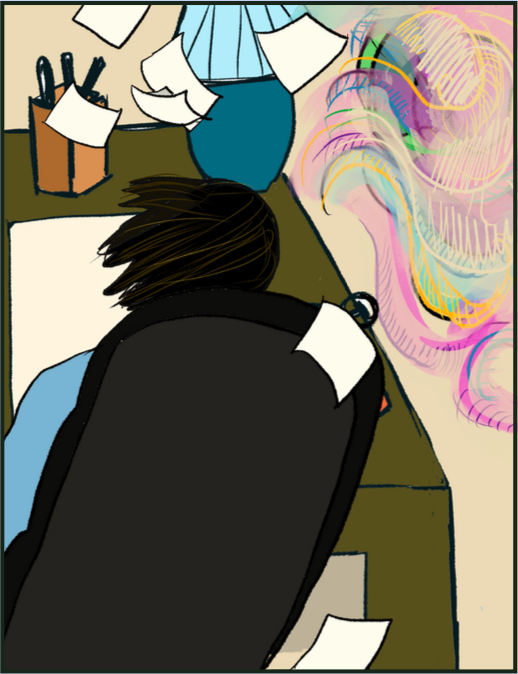
Here is a comic I made at the time, poking fun at the situation:

However, this situation wasn’t new. I haven’t been a stickler for organization, and usually, jumping into a project was my avoidance-tactic of choice. The housework and other errands managed to get done in erratic binges, and a rocky equilibrium was maintained.
What was different about this time was that the chaos was getting to me. And I knew I had to stay in the real world to sort it out. I couldn’t jump into Creative World without letting the situation back home get worse.
All the reading about the Hero’s Journey for my novel got me thinking about my creative projects as their own world that I projected into, sort of like the Spirit World in Avatar the Last Airbender. (I feel compelled to add that I was into ATLA before it got on Netflix and everyone started talking about it.)
In that show, your consciousness wanders the Spirit World while your body sits still without you. So you need to find safe circumstances to sit down and meditate, before you go exploring other worlds.
This is exactly what I was finding harder and harder to do.
The first problem was getting INTO Creative World, because my regular world was in chaos. I was scared I’d come back to a pile of overdue bills, an empty fridge, and missed appointments.
My second problem was that when I DID get in, I got stuck. I’m prone to hyper-focus, and since I visited Creative World so rarely, when I got there, I tried to do EVERYTHING. And I’d stay in for hours and hours, unable to pay attention to anything else. (And of course, those absences increased the disruption in my regular world.)
And lastly, since I was leaving long gaps between sessions on my project, I completely lost the thread each time I left. I’d steel myself to work on my novel, only to find I’d forgotten the story and had to read my notes as if they were someone else’s (if I could even find them).
The imagery of a portal to a separate world was stuck in my head. And solutions started to come into view as well – what could I do to make the entry easier, by first securing the premises in my regular world and getting organized?

Could I leave myself a map to get around the Creative world once there?

And could I make the return smoother and less disorienting, by NOT doing that dumb thing I do: rushing to get to the next task without getting my bearings?
I found specific tweaks I could make.
- A checklist for constraints and urgent matters to get out of the way before jumping through the portal.
- A log tracking what I did on the project each time, what needed to be done next, and where the work was stored.
- Consciously taking a moment to rest when I was done with a creative session.
It’s helped enormously. I’m finally working steadily on my novel and a giant (years-long) math project, after months of being too intimidated to touch them. I’m about a third of the way through my novel’s second draft now.
This framing has changed the way I think about how to be creative and prompted ideas for more tools I can develop specifically for each stage of a creative session – entering the portal, navigating Creative World, and the transition back to the regular world.
Want a fun resource, in the form of a fillable comic that will guide you through this process for your own creative projects?
Leaves and Foliage – In Botanical Ink


I’ve been on a bit of a painting kick – I dug up my bottles of botanical inks, bought a massive stack of watercolor paper, and sifted through hard drives of my vacation photos for nature references.
As I got the hang of the medium, I spent hours and hours each evening painting as I listened to podcasts or classes. I was hooked. When else does one look at nature photos that closely or for that long?
The effect was hypnotic. At the time, I was digging into climate research that was emotionally taxing. The harder it got, the more I painted to recover.
I’ve run out of ink now, but I still find myself staring at the leaves outside my window, tracing shapes in the air with my finger.
Want to give it a try? Even if you can’t get away to the middle of the wilderness, you can still get some nature time. Take a look at leaves or clouds – for a long time, way longer than seems sensible. Trace their shapes in the air.
What do you see that you would miss at a glance?
I’m working on developing the most eco-friendly art practice I can. That’s why I’m experimenting with botanical inks and watercolors, and Forest Stewardship Council certified watercolor paper.
My process isn’t perfect, but I’m learning a lot about sustainability, which I hope to apply to other aspects of my life too.
I’ll share more about my process as I refine it. As a preview, if you’re curious, here is my article about how I apply sustainability principles to my journaling practice.
Statistics is an instrument of truth.
You can make truer statements with statistics than without. Statements that apply to some fraction of people for some fraction of the time can be stated as such, instead of as absolutes.
No one ‘always’ does anything. If you said to someone “You always do this!” the statement can only be false.
‘All’ people of a certain demographic don’t do any one thing. “All women (or all men) behave a certain way”, is less true than a statement that specifies what fraction of men or women you mean, and how you estimated this fraction.
Degree of knowledge and applicability can only be expressed with completeness using statistical tools like sample size, probabilities, and likelihoods. Without them, you are stuck with either the wishy-washy ‘sometimes’ or the overconfident ‘always’.
The phrase ‘lies, damn lies, and statistics’ was created in response to bad practitioners of statistics — people waving their hands and deflecting from the truth with jargon they know their audience doesn’t understand, trying to give an impression they know is incorrect.
Horrible as this is, statistics is not inherently prone to promoting falsehoods. With greater literacy, statistics can be an instrument of truth with nuance and accuracy.
Originally appeared on Medium.